Friday, August 23, 2013

Senning's Park/Colonial Gardens

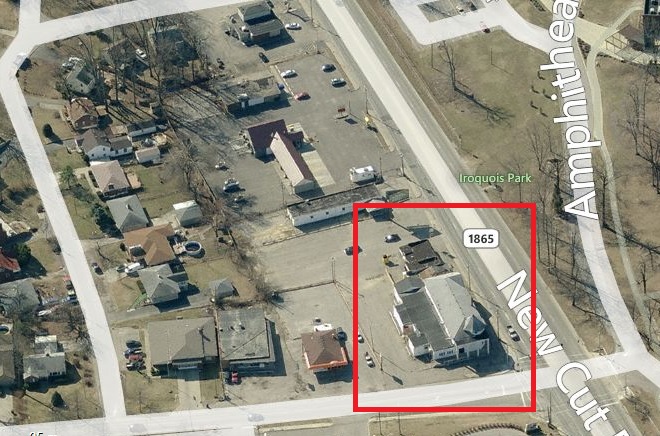
In South Louisville, Kenwood Dr. ends at New Cut Rd. Straight ahead is the entrance to one of Louisville's finest public spaces, Iroquois Park. Look left at that intersection though and you'll see a big, white, largely windowless building sitting vacant and in need of some TLC. It's not much to look at now, but believe it or not, for decades, it was a major Louisville hot spot. Built in 1902 by the Senning family, Senning's Park was a very popular restaurant, beer garden, and venue for indoor and outdoor functions. It's been said that six Kentucky governors accepted their nominations there. It was a sizable property - many of the businesses along that corner today actually sit on parcels of the original tract - and in fact, in 1920, Louisville's first zoo opened on its grounds. In 1939, after almost 40 years in the business, the Senning family sold the property, the zoo was closed and repurposed, and it was renamed Colonial Gardens, what most Louisvillians still call it today. From there, as the decades ticked away, ownership, names, functions, even the building itself changed, but it always provided a good time to patrons. In the '40s, it was big bands and dancing; in the '50s, hip teens; in the '60s and '70s, nightclub-style lounge entertainment. A cowboy honky-tonk was even tried once. It always adapted to the times and lasted all the way up 'til 2003 when it closed for good. The main building is deteriorating now and its spacious grounds have been eaten up by development and parking, but thankfully, there is an effort underway to save it and give it new life. Check out this story...

http://www.leoweekly.com/news/colonial-gardens-redux

UPDATE 8/23/15


Senning's Park, 1902 - 1939...


Colonial Gardens and property then...


Note: Kenwood Dr. is the road running along the shorter side of the building.

Colonial Gardens and property now...


Thursday, August 15, 2013

Baseball in Louisville

Baseball has been a part of Louisville's history for over 150 years. Of course, there's Hillerich & Bradsby's Louisville Slugger bats and equipment, but the game itself has been played here since 1858, professionally since 1871 (major league 1871 - 1899, minor 1899 - present). Team names and affiliations have changed many times over the years, and there have been a few periods when the city did not field a team: during the Civil War, 1878 - 1882, 1899 - 1901, 1962 - 1968, and 1972 - 1982.

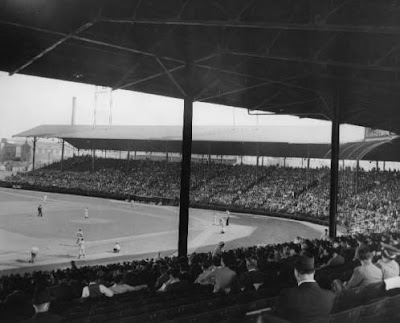
The first significant stadium was Eclipse Park at 28th and Elliott, built in 1871. It burned in 1892 then Eclipse II was constructed at 28th and Broadway. In 1899, it also burned and Louisville's major league franchise left town and was absorbed by the Pittsburgh Pirates. Major league ball has never returned to our city. By 1902 though, Eclipse III was built at 7th and Kentucky with a capacity of 8,500. It was the home of the Louisville Colonels minor league club and was a very successful venue. To this day, there's a street in that area named Base Ball Alley, named after a shortcut many fans used to get to the field from bustling 4th St. Like its two predecessors, it too burned in 1922.

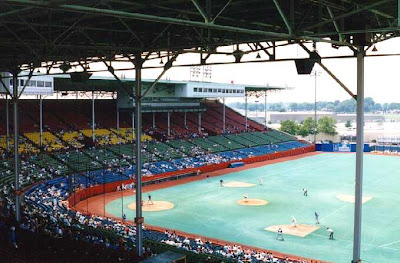
In 1923, Parkway Field was constructed at Brook and Eastern Parkway. It sat roughly 16,500 fans and was a monster park - left field 329', center 507', right 395'. Whether it was for charity, exhibition, minor league rehab, etc., many greats went up to bat at Parkway - Babe Ruth, Lou Gehrig, Pee Wee Reese, Ted Williams, Joe DiMaggio, even Jackie Robinson (1946 Little League World Series). This would be home to the Colonels 'til they moved to the new 20,000-seat Fairgrounds Stadium (Old Cardinal) in 1956. When they left, UofL's baseball team then made it their home for several decades. Note: Parkway's original grandstand was demolished in the 1960s.

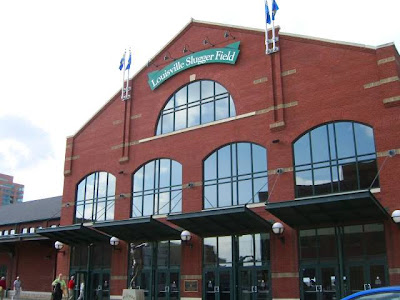
As the 20th century gave way to the 21st, Louisville's minor league team, now named the RiverBats, moved from Old Cardinal Stadium to a new facility downtown - the fantastic Louisville Slugger Field. The main concourse of the park is actually the old Brinly-Hardy Tractor Supply Co., which is great reuse of a historic building. UofL baseball also got a new home - Jim Patterson Stadium. Parkway is nothing but an open field now. Old Cardinal Stadium, while it's still standing and part of the Kentucky Fair and Exposition Center, is essentially condemned and slated for demolition in the coming years.
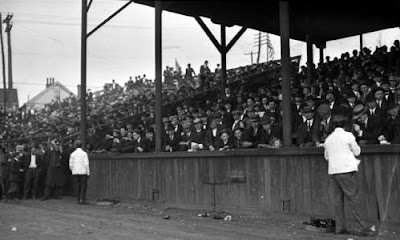

Eclipse Park III

Parkway Field

Fairgrounds Stadium/Cardinal Stadium/Old Cardinal Stadium


Louisville Slugger Field

Sunday, August 11, 2013

Fontaine Ferry Park

From 1905 - 1969, if folks in Louisville were looking for a day of fun, all they'd have to do is take Market Street west 'til it ended at the gates of Fontaine Ferry (called "Fountain Ferry" by many). It was a full-fledged amusement park with giant coasters and other rides, games, food, entertainment, a large swimming pool, you name it. There are a lot of great photos of "Fountain Ferry", but honestly, the website below, devoted to the park, has everything you'd want to know. Sadly, the racial unrest of the 1960s spilled over into the park, and on May 4, 1969 (opening day), it was rocked by rioting, theft, and vandalism. Damage was severe, and "Fountain Ferry" never reopened. Ownership changed hands, it reopened under different names but never succeeded, then the property sat vacant. In 1981, the city cleared the site and turned it into a public park.

Lost Community: Shippingport

Check out the two maps of Louisville below. The first is from the mid-1800s; the second is now. Look in the red rectangles. Notice how that island out in the Ohio River has shrunk and changed shape over time? Notice the streets that no longer exist? That's Shippingport, and 200 years ago, it wasn't even an island; it was a peninsula. Founded in 1785, it's one of the oldest parts of Louisville and once bustled with homes, schools, businesses, industries, etc. just like any other neighborhood. However, when the Louisville and Portland Canal was built (1825 - 1830), it cut Shippingport off from the rest of Louisville and made it an island. Over time, canal expansion, the construction of a hydroelectric power plant, and the 1937 flood further eroded Shippingport's land area, population, and prosperity. Finally, in 1958, the federal government came in and shooed off everybody who was left on the "island." Today, Shippingport is nothing but McAlpine Locks and Dam administration, a little industry, and woods. Kind of sad really.


The Southern Exposition, 1883 - 1887

And while I'm on the topic of fairs, from 1883 - 1887, Louisville was home to the annual Southern Exposition - just think slightly smaller World's Fair. Festivities were opened the first year by none other than the President of the United States himself, Chester Arthur. It promoted strengthening the economic bond between the North and South (this was only 18 years after the end of the Civil War) and highlighted agricultural technology, machinery, Thomas Edison's new electric light, and even art, music, and recreation. The exposition's grounds consisted of 40 or so acres around what is now St. James Court, Central Park, and "Old Louisville" residential. The main building had 13 acres of floor space, and according to John Kleber in The Encyclopedia of Louisville, may have been the largest building in the world made entirely of wood. It was demolished two years after the exposition closed to make way for new homes.   


Old Kentucky State Fairgrounds

It's August in Louisville, which means it's Kentucky State Fair time. It's held annually at the Kentucky Fair and Exposition Center, opened in 1956 and located on over 400 acres of prime urban real estate near the airport. But the event has been a fixture in Louisville since long before 1956. The first fair was held in 1902 at Churchill Downs. It went to Owensboro the next year, there was no fair in 1904 (legal matters), Lexington hosted in 1905, and it came back to Churchill in 1906. Then the state decided a permanent site was needed. It picked 150 acres in West Louisville bordered by Southwestern Parkway on the west, Gibson Ln. at the south. Over the years, the state built a sprawling complex that was home to the fair 'til it moved in 1956. The highlights of the facility were the Pavilion for shows (third photo) and the Merchants and Manufacturers Building for exhibits (bottom three). The latter survived and remains in use today by Whayne/Caterpillar Supply Co.


Saturday, August 10, 2013

Commonwealth Building: Request for Information

Of all the old structures I've featured on this blog, the Commonwealth Building has given me the most trouble. I did a general post about it a long time ago, but finding more in-depth information and photos of it has proven extremely difficult. It sat at the NW corner of 4th and Broadway, and while it was an ugly, unremarkable building and changed hands several times (it may have changed names as well which could be the reason it's hard to research), it was Kentucky's tallest building in the 1950s and 60s and had a prominent Louisville location. So, if anyone has information, stories, or nice photos of the building, please let me know and I'll feature them on here. Thanks, Philip Campbell.  

Monday, May 20, 2013

Frankfort, KY

Located less than an hour from downtown Louisville is Kentucky's beautiful little capital city, Frankfort, population 25,000. I'm not going to get into its rich history - that could be a blog of its own - but here are some pictures I've taken of the downtown area and the Capitol. It's an impressive structure and in my opinion, holds its own against any capitol building in the county save the US Capitol in DC. The city photos were taken May 2013; Capitol, April 2012.

Friday, May 3, 2013

Louisville's Breweries

All across the world, people are familiar with Kentucky's fine bourbon, and Louisville's played a big part in building the brand - and continues to do so. What's not common knowledge though is throughout it's history, Louisville's also been home to literally dozens of breweries. Some were a flash in the pan; others enjoyed decades of regional, national, even global success. They're all gone now, but it's good to look back and remember them. I'll highlight the largest three...


Oertel's, Story Ave. and Webster, 1892 - 1967. Part of their complex still remains (first photo, smaller building to the right). One of my prized possessions is an Oertel's bottle opener :)


Frank Fehr, Liberty St. between Preston and Jackson, mid-1870s - 1964, bought by Schoenling of Cincinnati. Dosker Manor housing complex currently occupies the site. Note: In the first photo, the building at right is now First Link Discount Foods (significantly remodeled).


Falls City, 31st and Broadway, 1905 - 1978. Much of the facility is still there. I could not find a good picture of it in it's prime, but here's what it looks like today. Also, Falls City Beer is back in production. Different company, different site, and I believe a different recipe, but I'm glad the name's back in use.


Sunday, April 7, 2013

The Big Four Bridge: Update

A while back, I posted “The Big Four Bridge and Why Spaghetti Junction Is the Way It Is.” I mentioned that Kentucky and Indiana were in the process of converting the old bridge into a pedestrian walkway, tied into parks on both sides of the Ohio River. As of April 2013, it is nearly complete. The bridge and Kentucky point of access are done, Indiana is finishing its ramp now, and it’s finally open to foot and bike traffic. My wife and I had the pleasure of taking it in for the first time this weekend. Beautiful work. All of our historic structures should be treated this way - reused rather than destroyed. Here are a few pictures from our walk. The last shot is of the concrete bases that once supported the bridge’s approach from the Louisville side.